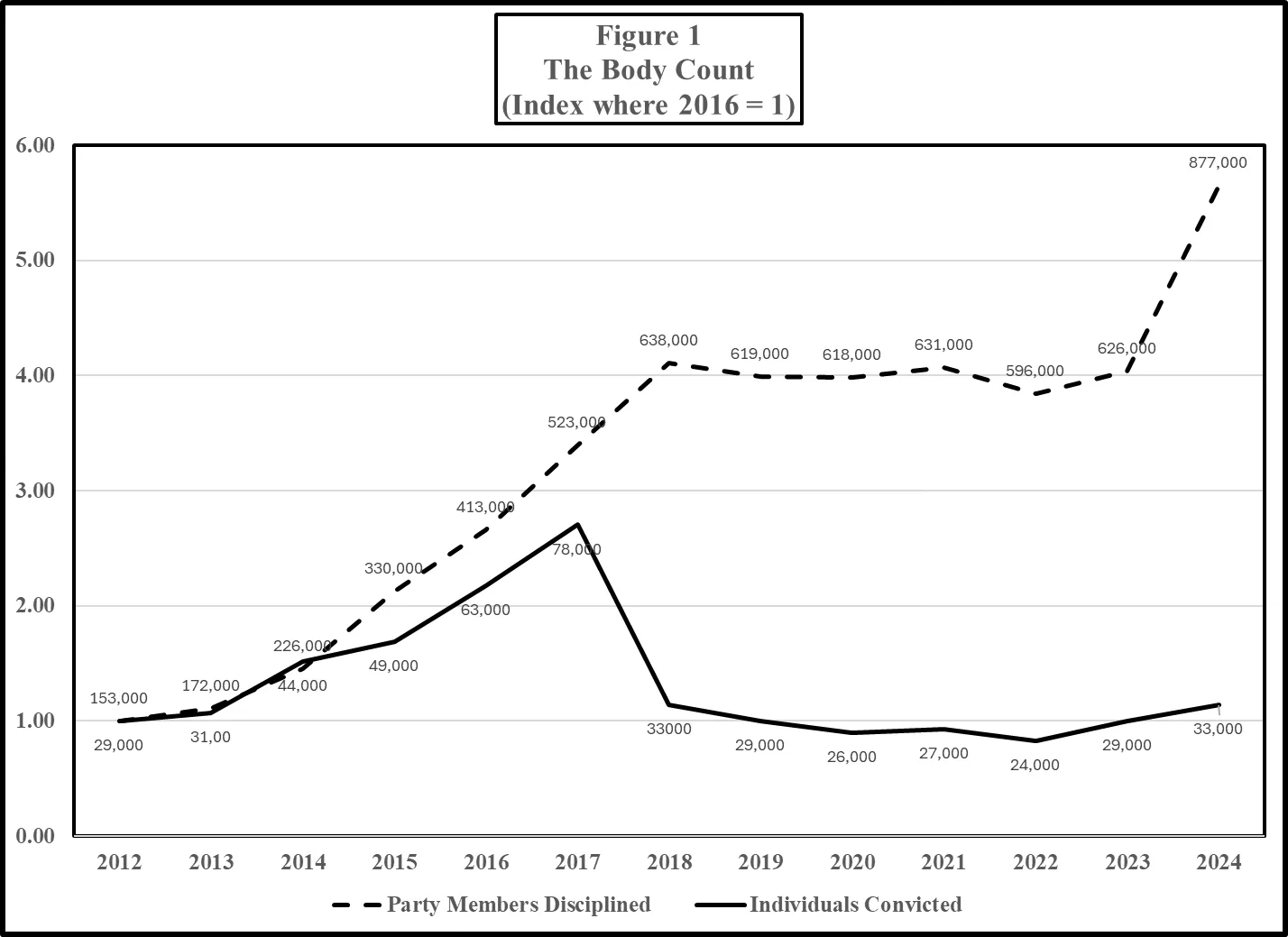
Introduction In October 2017, Xi Jinping told the delegates to the Nineteenth Party Congress that during the past five years, the Party’s “anti-corruption campaign has built into a crushing tide and is being consolidated and developed.” He cautioned, however, that: the fight against corruption remains grave and complex; we must remain as firm as a rock in our resolve to build on the overwhelming momentum and secure a sweeping victory.1 Five years later in October 2022, Xi told the delegates to the Twentieth Party Congress: We have achieved an overwhelming victory and fully consolidated the gains in our fight against corruption. All this has helped remove serious hidden dangers in the Party, the country, and the military and ensured that the power granted to us by the Party and the people is always exercised in the interests of the people.2 In July 2024, the communique issued at the close of the Third Plenum of the Twentieth Party Congress, called on the Party to “redouble” the drive against corruption and “advance the campaign to increase awareness of party discipline, safeguard the Party's solidarity and unity, and continue to enhance the Party's creativity, cohesion, and ability.”3 More recently in January 2025, Xi told delegates to the Fourth Plenum of the Twentieth Central Discipline Inspection Commission that the party must persevere in the “tough, protracted fight against corruption.”4 In an analysis published in China Currents in 2019, I concluded that, Xi’s seemingly optimistic assessments notwithstanding, it was not clear the anti-corruption drive had, in fact, achieved substantial gains.5 The lack of “victory” was, I continued, not surprising because the party’s fight against corruption is best understood as a protracted war of attrition, not a decisive blitzkrieg. Today, over a decade after Xi launched an unprecedented attack on high-level corruption, it appears that the party’s war has bogged down. Despite Xi’s claims of victory, the numbers of corrupt senior functionaries,6 which the Chinese press calls “tigers,”7 detained in the past several years rival the numbers detained during the early years of the drive. Even more ominously, during 2023 and 2024, Xi apparently felt the need to cleanse the senior ranks of the People’s Liberation Army (PLA) for a second time. It thus appears that, like the United States in Vietnam during the 1960s, Xi now finds himself in a quagmire. In fact, Xi’s repeated claims of imminent victory sound rather similar to General William Westmorland’s late 1967 claim that steadily rising body counts of dead Viet Cong guerrillas and North Vietnamese Army (NVA) regulars showed that the U.S. military was grinding the enemy down and moving toward the light at the end of the Vietnamese tunnel. Just two months later, the Tet Offensive shocked Americans into realizing that victory was not at hand. Xi, too, has bagged a lot of tigers, including retired Politburo Standing Committee member Zhou Yongkang; Politburo members Bo Xilai and Sun Zhengcai; Vice Chairs of the Central Military Commission and Politburo members Gen. Guo Boxiong and Gen. Xu Caihou; and Defense Ministers Wei Fenghe and Li Shangfu; and swatted a mass of “flies” (rank-and-file functionaries).8 The recent upsurge in the number of tigers detained and what looks like a second significant purge of the PLA, however, suggests that he is not close to rooting out corruption. The light at the end of the Chinese corruption tunnel thus seems dim and distant. The Body Count Xi has certainly achieved an impressive body count. Between 2013 and 2024, the Supervisory Commission and its predecessor, the Central Discipline Inspection Commission (CDIC), punished 6,272,000 party members.9 Between 2013 and 2024 the courts convicted 466,000 individuals on corruption charges.10 As of December 2024, 417 senior state officials, party cadres, and managers of major state-owned companies and banks had been detained and 126 senior military officers detained, sacked, or demoted. Impressive as the punishment of almost half-a-million state functionaries each year for corruption might seem, data suggest that much like the U.S. war effort in Vietnam, Xi’s attack on corruption began with dramatic increases but then leveled off in 2018 (see Figure 1). In 2024, however, the number of party members investigated shot up 40% from 626,000 in 2023 to 877,000 in 2024.
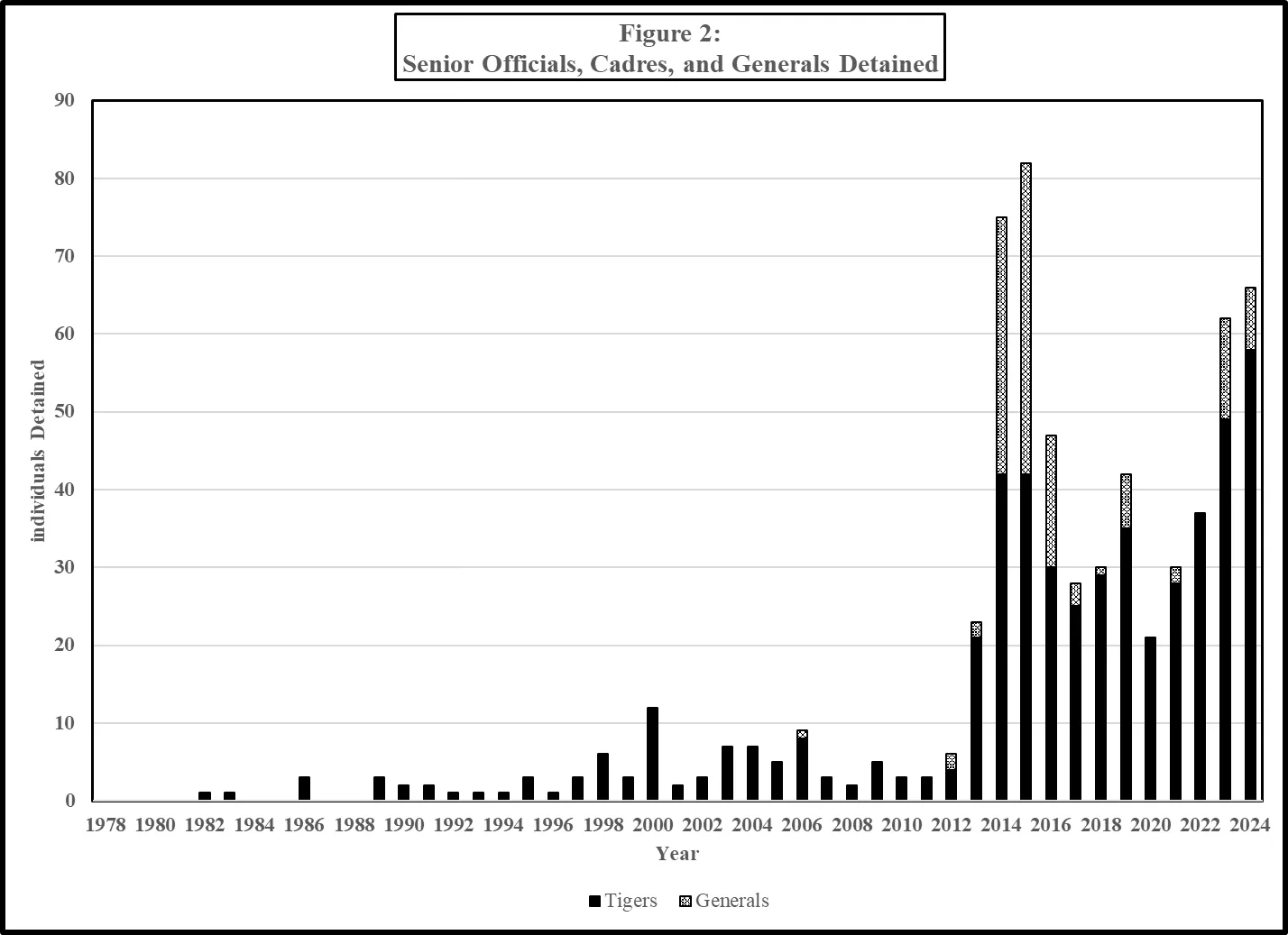
The number of senior functionaries charged with corruption, meanwhile, jumped from four in 2012 to 24 in 2013, rose to 41 in 2014, and then peaked at 47 in 2015 (see Figure 2). The number of senior military officers allegedly under suspicion also jumped from just one in 2012 to 23 in 2014 and 53 in 2015.11 After 2015, the number of tigers and senior military officers charged with corruption fell, but remained multiple times higher than in the years prior to the crackdown. In 2022, the numbers began to rise, with 40 tigers detained that year, 50 in 2023, and then 59 in 2024.
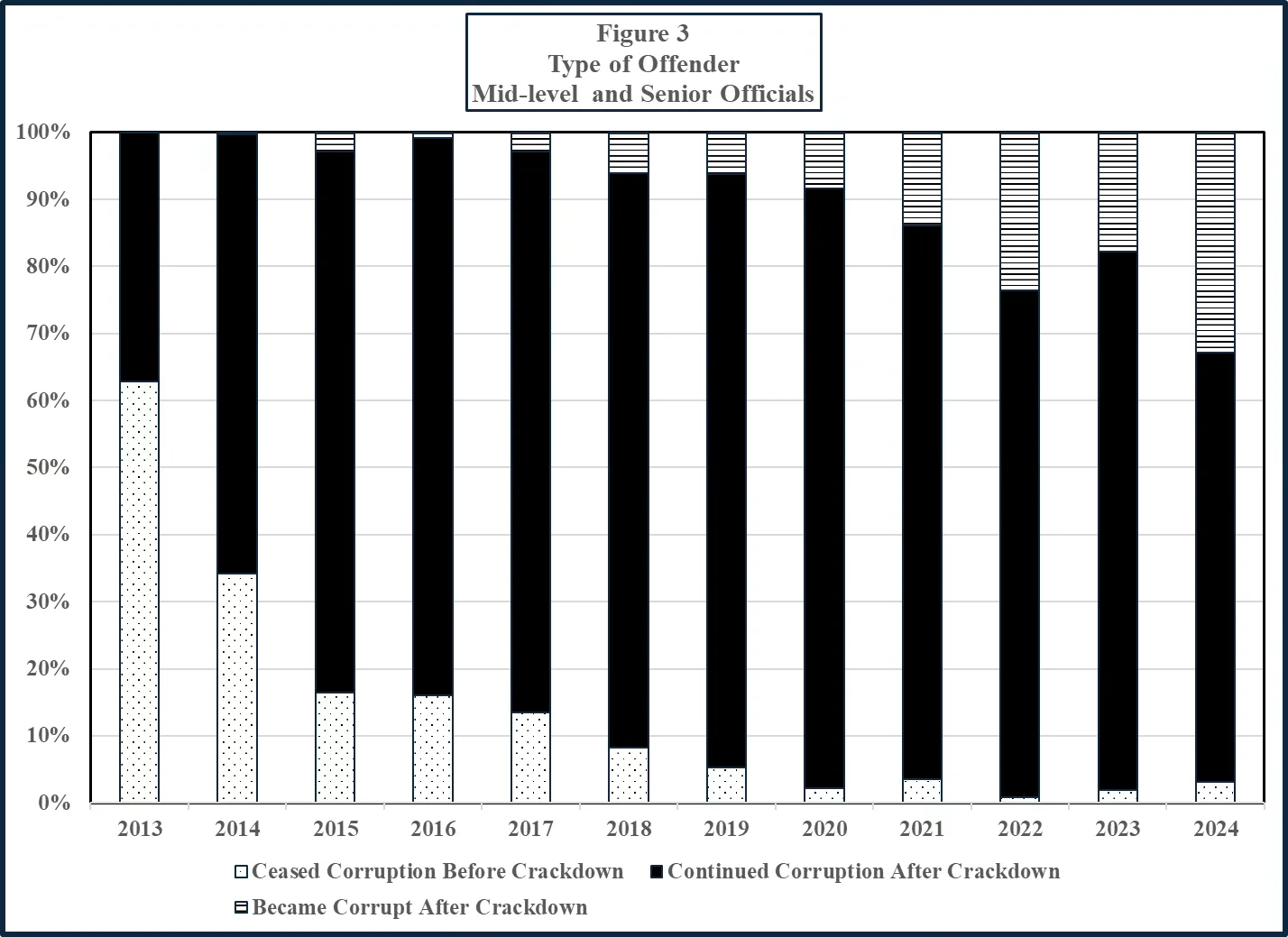
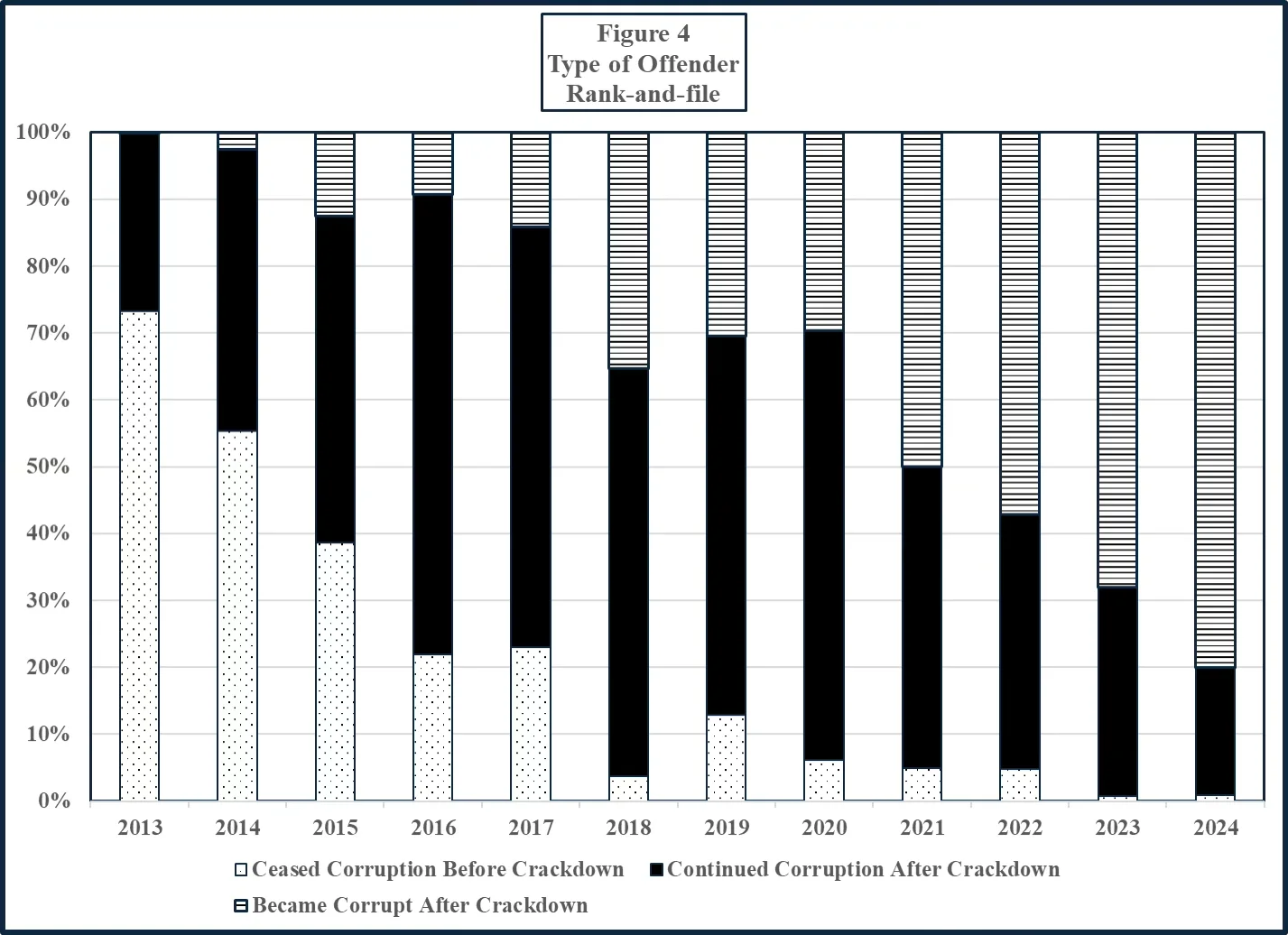
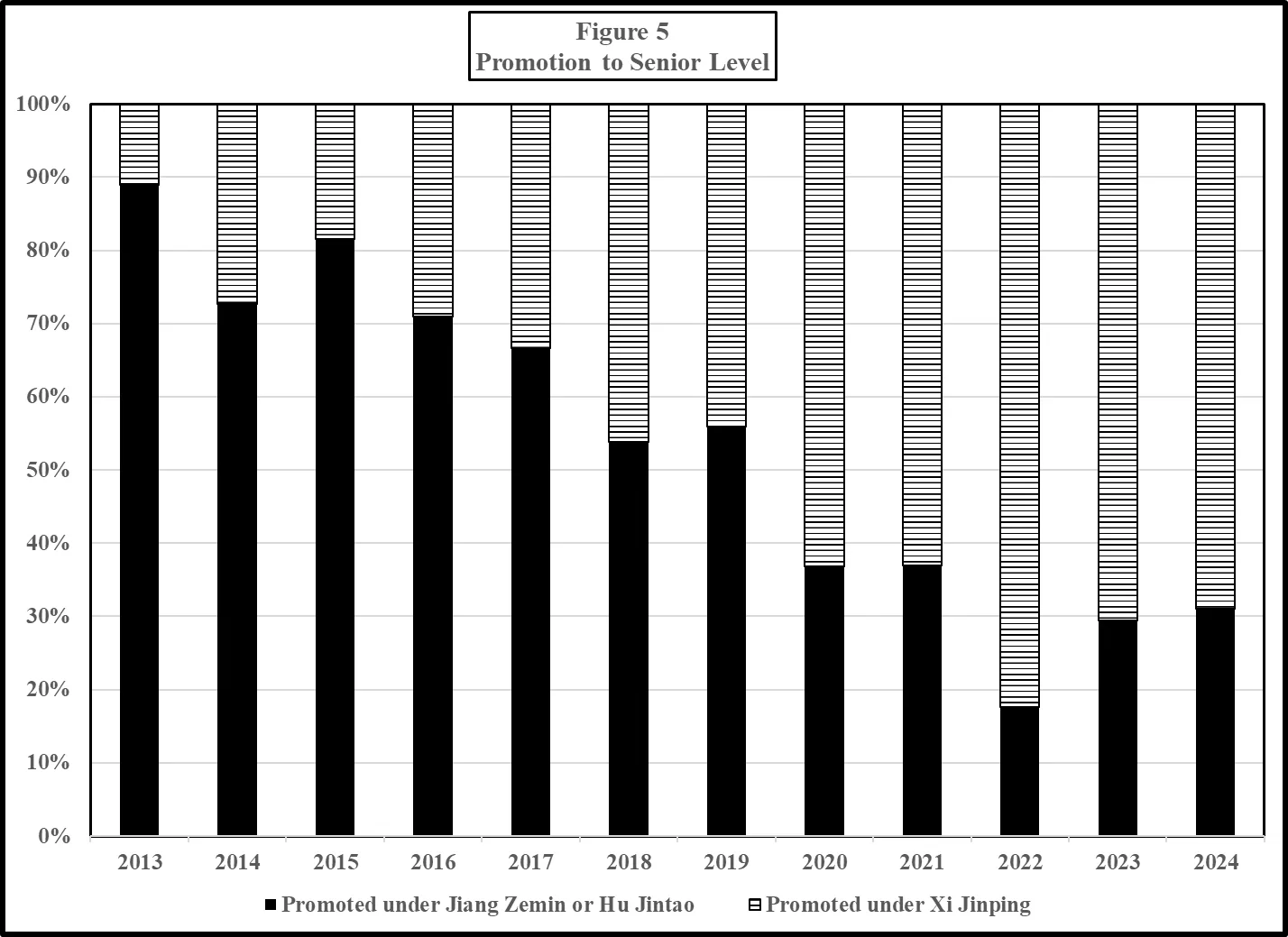
The aggregate data thus reveal a divergence between a surge in party disciplinary actions and a relatively stable trend in the number of criminal cases involving corruption and a second divergence between the number of low- and high-level cases. The gap between the hundreds of thousands of party members sanctioned by the Supervisory Commission annually and the “mere” tens-of-thousands of individuals indicted and convicted results from two factors. First, the Supervisory Commission investigates a range of disciplinary violations, not all of which are linked to corruption. Second, not all cases involving corruption reach the threshold for criminal punishment. Although the Supervisory Commission does not break down its disciplinary actions by type of infraction, it appears that the bulk of its case load involves run-of-the-mill violations of discipline;12 more serious abuses of official authority; dereliction of duty and negligence; and petty corruption. The “surge” in party disciplinary actions thus appears to involve non-criminal offenses for which individuals are generally penalized by party and/or administrative sanctions such as warnings, demotions, dismissal from office, and expulsion from the Party rather than being sent to prison.13 Third, not all party members subject to disciplinary measures hold official positions or party posts. Two-thirds were, according to the Supervisory Commission, simply party members. Bloodied But Not Broken During the Vietnam War, American commanders asserted that as the bodies piled up, the size of the enemy’s forces would diminish, and ultimately the enemy would be pushed to its breaking point and resistance would collapse. The strategic logic of Xi’s anti-corruption drive can be cast similarly. First, it assumes that as more flies are swatted and more tigers caged, then there must be fewer flies buzzing about and fewer tigers roaming the jungle. Second, as the piles of swatted flies grow and the number of tiger pelts nailed to the walls of Zhongnanhai increase, other functionaries will come to fear they cannot escape the piercing eyes of party investigators and will cease using their delegated authority to seek personal gains. Third, concurrent party-building and administrative reforms will win over functionaries’ “hearts and minds” and reduce the bureaucratic slack that creates opportunities for functionaries to engage in corruption. Ultimately, this combination of intensified top-down anti-corruption enforcement and bottom-up institution building will tighten the leadership’s grip on the party-state and allow Xi to “win” the Party’s long-running war with corruption. In key respects, a corruption crackdown is as much psychological warfare as it is a search-and-destroy operation. We can conceptualize corruption as a repeated-play, iterated game of chance in which a functionary chooses between honesty and corruption, with honesty having a neutral payoff and corruption offering a greater payoff. The latter choice, of course, comes with the risk of being caught, punished, and hence suffering a negative payoff. In theory, the functionary’s choice will be based on the relative expected value of honesty and corruption. If a functionary opts for corruption, they not only risk getting caught “red-handed” each time they engage in corruption but also face an open-ended risk of being caught even if they do not engage in new corruption. A crackdown on corruption causes an increase in the risk of punishment. When such an increase occurs, functionaries who have opted for corruption previously will presumably re-evaluate their choice and decide whether to continue to engage in corruption. If corrupt functionaries believe the crackdown has increased risk beyond their subjective risk threshold, they ought to cease and desist. Theretofore honest functionaries also face increased risk and should continue to eschew corruption. If, however, corrupt and honest functionaries alike dismiss the increased risk as inconsequential, then corrupt functionaries should continue to engage in corruption and some theretofore honest functionaries may opt for corruption. Despite having punished more than 5.7 million party members for disciplinary infractions, including 1.5 million who held official or party positions, and convicted almost 470,000 functionaries, including upward of 550 senior cadres, officials, and military officers, since 2013, Xi’s anti-corruption agencies continue to uncover over half-a-million malfeasant functionaries and party members each year. More critically, despite all its sound and fury, Xi’s crackdown has apparently failed to yield a Marxist “come to Jesus” epiphany that would call China’s corrupt functionaries back to the straight and narrow. Two indicators, I believe, strongly suggest that Xi is not winning the war on corruption. First, data show that substantial numbers of functionaries who were corrupt before the crackdown continue to take bribes and embezzle public monies even though intensified enforcement putatively increased the risk of capture and punishment. Others actually turned corrupt in the midst of the crackdown. Three-quarters of accused individuals holding leadership roles at the county and department levels had turned corrupt before 2013 and continued to accept bribes and steal public funds after the crackdown unfolded (see Figure 3).14 Among the rank-and-file (i.e., flies) in recent years, more than half those charged turned corrupt during the crackdown (see Figure 4). Second, a number of mid-level functionaries whom Xi promoted to replace the corrupt tigers promoted by his predecessors were subsequently charged with corruption (see Figure 5). Perhaps even worse, many of those Xi promoted proved to have been engaged in corruption at the time they were promoted. In fact, of 210 functionaries promoted into the senior ranks since 2013 who were charged with corruption, 134 were found to have been corrupt at the time they were promoted. It seems likely that many others may have been corrupt when they were promoted. At the time of this writing, however, they remain “under investigation” and details about their offenses have not been revealed.
In sum, claims that functionaries became “paralyzed” by fear after Xi’s crackdown on corruption notwithstanding, the data suggest that fear has not deterred many from continuing their bad ways. And others – including members of the rank-and-file who, one would think, would be the most vulnerable because of their limited power – gave into temptation for the first time even though the risk of getting caught had presumably increased.15 Even worse, it appears many of those Xi picked to replace corrupt tigers were also themselves corrupt. It would seem, therefore, that after a decade-long, highly publicized drive against corruption, neither the flies nor the tigers are close to extinction or have become endangered species. Nor does Xi seem to have won over the hearts and minds of functionaries and restored their commitment to being upright Communists dedicated to selflessly serving the people. Regime Integrity Although corruption often involves isolated functionaries or relatively small groups of conspirators, these individualized crimes have a cumulative impact on the integrity of a state’s governing institutions. Corruption can be defined as the usurpation of fiduciary authority delegated by a principal to an agent for the private gain of the agent. Although such personal gain may involve money, if we put the purpose of usurpation aside, then corruption becomes a form of willful, self-serving insubordination by an agent. As such, big money corruption and petty corruption are functionally identical to each other and to a wide range of official malfeasance and misbehavior, including dereliction of duty, willful negligence, and even sloth and foot-dragging. Insubordination, in fact, figures prominently in the list of infractions leveled against those expelled from the party by the Supervisory Commission. Offenders are regularly accused of violating political discipline and being disloyal to the party, forming gangs and cliques, obstructing investigations, failing to implement decisions of the Central Committee, manipulating official appointments and promotions, engaging in superstitious activities, failing to discipline and educate their families, leading degenerate lives and pursuing low interests, trading power for sex, and bringing disrepute on the Party and government. Other common charges include embezzling state funds, accepting improper gifts and invitations, protecting criminal syndicates, paying bribes, accepting bribes, and having unexplained assets. Corruption, in short, is cast not only as a criminal offense but rather as a manifestation of deep moral turpitude and a failure to wholeheartedly obey the Party’s political principles and its ethics code. Widespread insubordination erodes the integrity of institutions, particularly if it is present at multiple levels. Because China is organized as a unitary state in which all levels of the state are part of a single power structure, the Chinese party state can be described as a multi-layered hierarchy of principal-agent relationships at whose apex sits the Politburo overseeing 33 first-level territorial agents (provinces) and some 80 first-level bureaucratic agents (ministries, commissions, etc.).16 These first-order agents are in turn principals for 333 second-order territorial agents (cities and prefectures) and numerous state bureaus. These second-order agents are then principals for 2,850 third-order territorial agents (urban counties and rural counties) and a host of bureaucratic departments. These third-order agents are then principals for 39,883 fourth-order territorial agents (urban sub-districts and rural townships) which form the bottom rung of the formal state, and a myriad of low-level bureaucratic offices. These fourth-order territorial agents, finally, act as principals for 662,393 fifth-order agents (village and neighborhood committees) that are technically “social organizations” but nevertheless serve as the grassroots agents of the party-state. The paramount leadership is also the principal for a hierarchy of party committees and units that parallel and intertwine via shared personnel with the state hierarchy, as well as the military. Over the past decade, the Supervisory Commission has punished a million-and-a-half public functionaries at all levels of the party state (see Table 1). Given that there are some 40 million public functionaries, including perhaps 7 million working for various state agencies,17 the Supervisory Commission’s annual average of 197,000 disciplinary cases between 2016 and 2024 implies that less than 3% of the party-state functionaries are guilty of serious insubordination. The number of functionaries punished, however, represents a fraction of those engaged in insubordination and corruption. If, as argued previously, we think of corruption as an iterated game of chance in which corrupt functionaries must “roll the dice” repeatedly with a risk of getting found out and punished each time, then the length of time they “remain in the game” before getting caught provides a rough proxy for the odds of getting caught. The odds derived from data on the lag between crime and capture, however, understate the true odds because some share of those engaged in corruption presumably never get caught. With that caveat in mind, the available data suggest that corrupt functionaries managed to “get away” with their crimes for not insubstantial periods, with rank-and-file functionaries managing to evade capture for an average of over five years and having a one-in-four chance of evading capture for seven years. County-level functionaries averaged more than 11 years and had a one-in-four chance of evading capture for 15 years. City-level functionaries averaged over 14 years and had a one-in-four chance of evading capture for 18 years. Senior functionaries averaged 17 years and had a one-in-four chance of evading capture for 21 years. Moreover, the average time between when an official turned corrupt and when they were captured increased for all levels, which implies that the risk of capture decreased over time (see Table 2).
Source: The Central Commission for Discipline Inspection and the National Supervisory Commission Report on Supervision, Inspection, Review and Investigation, various years, available at http://www.ccdi.gov.cn.
Source: Author’s database. The pyramidal structure of principal-agent relationships that links the center to the myriad state institutions and their staff compounds the problem of insubordination and malfeasance by interposing unreliable agent-cum-principals at intermediate levels of the hierarchy. A corrupt provincial party secretary or governor, for example, degrades the central leadership’s ability to ensure that functionaries within a province are held to strict disciplinary standards and that the province’s leadership does not turn a blind eye to insubordination and corruption at the municipal, district, and county levels. Similarly, corrupt county party secretaries and magistrates degrade the ability of the central and provincial leadership to ensure the fidelity of functionaries at the grassroots level. Problems of control are further worsened by the presence of corruption in the public security and supervisory organs tasked with policing society and disciplining the party-state.18 We can illustrate the cascading effect of corruption on regime integrity with a chained probability model. Given that the Supervisory Commission disciplined an average of 3% of officials and functionaries each year — and assuming it catches all violators each year — the odds that a single chain, or leg, of principal-agent relationships from the center to the grassroots is “clean” would be 85%. If we more realistically assume that the Commission catches only a fraction of violators each year, the odds that a leg is clean fall dramatically as the probability of capture decreases. Furthermore, given that the data reported in Table 2 suggest that grassroots cadres evaded capture for an average of over five years and senior officials evaded capture for an average of over 10 years, the overall odds of capture would be at a minimum between one-in-five and one-in-ten. Applying chained probability to these numbers yields estimates that less than half and perhaps fewer than one in five legs of the party-state would be free from corruption and official malfeasance (see Table 3).
Note: Estimates based on prevailing 3% punishment rate. In sum, the data indicate that despite having piled up a high body count, Xi’s crackdown has not deterred functionaries from engaging in corruption and insubordination, with the result that corruption remains a significant threat to the integrity of the party state. Conclusion Despite a decade of trying, contrary to what some have claimed, Xi has failed to transform China into a “perfect dictatorship”19 Instead, Xi exercises imperfect control over the party-state. He may have eliminated would-be factional rivals and taken down hundreds of thousands of individuals who have defied his demands for honesty. But he has failed to rid the party-state of what he and his predecessors have called the “cancer of corruption” and has not fully consolidated his grip on the party-state apparatus. Moreover, Xi’s ongoing tiger hunt has shown that the cancer of corruption is not only a disease of the skin that infects the rank-and-file, but a cancer of the heart that has metastasized into the senior ranks and infects not only functionaries picked by Xi’s predecessors, but even those Xi selected himself. Xi thus remains mired in a quagmire of corruption. So long as he remains committed to maintaining the party’s monopoly on political power, however, Xi cannot afford to quit fighting hard because, even though he has been unable to cleanse the party-state of corruption, his intensified drive against corruption helps ensure that the party-state remains sufficiently intact to govern China, albeit corruptly. Notes
| ||||||||||||||||||||||||||||||||||||||||||||||||||||||||||||||||||||||||||||||||||||||||||||||||||||||||||||||||||||||||||||||||||||||||||||||||||||||||||||||||||||||||||||||||||||||||||||||||||||||||||||||||||||||||||
Quarterly essays on greater China by scholars who study the region closely, plus notice of our Atlanta events. Published continuously since 2002.