Post-Pandemic Transformations: Evaluating China's Climate and Air Quality Situation in the Wake of COVID-19 
By Eri Saikawa
Professor and Chair, Department of Environmental Sciences (ENVS), Emory College of Arts and Sciences; Professor, Gangarosa Department of Environmental Health, Rollins School of Public Health; Director, Emory Climate Hub
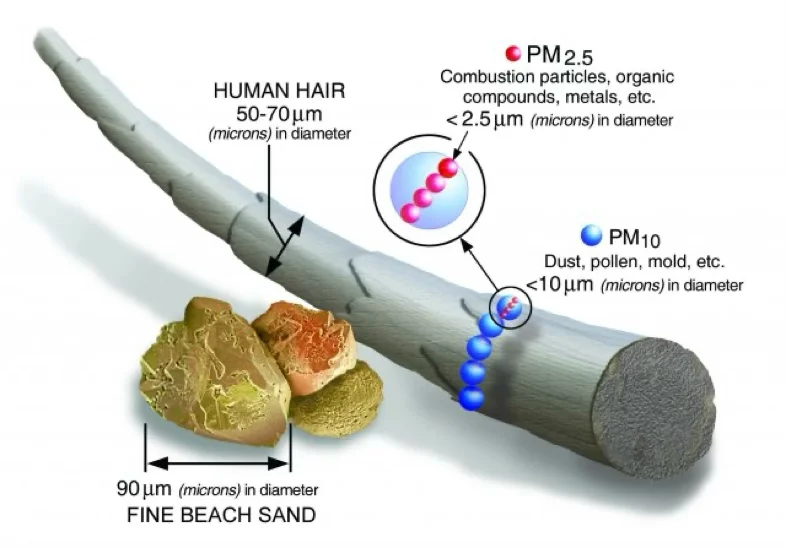
In 2014, Prime Minister Li Keqiang declared an all-out war on air pollution (Zhang et al, 2021). For the next eight years, the data proclaimed China’s victory. In 2019, the average annual concentrations of PM2.5 –– the particulate matter with an aerodynamic diameter of up to 2.5 microns (Figure 1) –– fell an impressive 50 percent from 2013 to 36 micrograms per cubic meter (μg/m³) (Zhang et al, 2021).
These numbers continued to drop during the COVID-19 pandemic as global economic activity ground to a halt. By 2022, PM2.5 concentrations in 339 major Chinese cities had reached 29 μg/m³ (Huang, 2024). Although tropospheric ozone— another air pollutant— was not substantially reduced during the pandemic, overall, the sky was blue (Zhang et al, 2021). But it is too early to celebrate. Industry has come back in full force and so has the level of particulate matter in the atmosphere. Post-COVID air quality policy indicates that government leaders continue to sway between prioritizing rapid economic expansion and appropriate environmental action. China is at critical point in the road, one that influences not only their nation’s next few years but also the global future of sustainable development. THE REBOUND It almost seemed as though China’s air pollution was a problem of the past. However, in 2023, new data emerged showing that this was the first year the national average PM2.5 concentrations increased since Prime Minister Li Keqiang declared the plan to combat air pollution. With the lifting of pandemic restrictions and a global return to normalcy, it was clear that economic growth had become China’s top priority once more. From January to November 2023, PM2.5 concentrations in Beijing surpassed double the national standard of 35 μg/m³, with a near-complete rebound to erase the progress made in nearly a decade. In 2023, 13 of 31 provincial capitals failed to meet the PM2.5 national standard, and 11 failed to meet the ozone national standard (Qiu, 2023). However, even if China’s air quality national standards had been met, they do not imply there is no impact on human health because currently, there are no safe levels of air pollution exposure based on the existing studies (WHO, 2021). It is also important to note that while US has lowered its annual PM2.5 standard to 9 μg/m³ in 2024, the World Health Organization (WHO) has various interim target levels (Table 2), along with air quality guideline levels of 5 μg/m³. Table 2. Recommended Annual Air Quality Guideline Levels and Interim Targets for PM2.5
COVID showed us that reduced economic activity decreases the emissions of prominent greenhouse gas carbon dioxide (CO2) in addition to PM2.5, but the brevity of the reduction did not significantly improve the global climate crisis. Furthermore, short-lived pollutants that contribute to poor air quality like PM2.5 may have dipped during the pandemic, but ozone pollution didn’t. Today, with economic considerations spearheading the decision-making processes of most countries, air quality and climate issues have worsened and will continue to do so. How should a nation navigate these conflicting priorities? China’s policies on sustainable development could be an indicator of what works and what doesn’t. POLICY ACTION POST-COVID In terms of air quality, China has taken actions to address the recent rebound in PM2.5 levels. On December 7, 2023, China’s State Council issued the Action Plan for Continuous Improvement of Air Quality, which targets three main regions: 1) the Beijing-Tianjin-Hebei region and neighboring areas, 2) the Yangtze River Delta, and 3) the Fenwei Plain regions. This covers some of the regions with the highest PM2.5 concentrations in autumn 2023 and winter 2024, including but not limited to parts of Hebei, Henan, Shaanxi, Shanxi, as well as capital city Beijing and China’s largest city Shanghai and nearby Jiangsu province (Liu, 2024; Qiu, 2024a). The following includes some of the objectives to be achieved by 2025, with reference year 2020 (Liu, 2024):
The Continuous Improvement action plan seeks to promote sustainable development by banning new steel production and creating green industries. Additionally, the plan outlines goals relating to the development of clean and low-carbon energy. Measures will be taken for non-fossil energy to account for 20% of China’s total energy consumption by 2025. Transportation-wise, China intends to accelerate the development of new energy vehicles (NEVs), which include battery electric vehicles, plug-in hybrid vehicles and fuel cell vehicles (Kang, 2024). The plan aims for NEVs to account for at least 80% of new or updated urban public transport vehicles within the target regions (The State Council of the People’s Republic of China, 2023). The Action Plan also includes efforts to improve the enforcement and implementation of environmental policies. Specifically, the State Council seeks to amend the Clean Production Promotion Law, clarifying legal responsibilities of companies in using low-VOC production materials (Liu, 2024). China has also laid out climate-specific intentions for the coming years. In 2022, the Ministry of Ecology and Environment released China’s Policies and Actions for Addressing Climate Change,1 a report reflecting China’s action under the broader Xi Jinping Thought on Promoting Ecological Civilization (Ministry of Ecology and Environment of the People’s Republic of China). The document summarizes progress in responding to climate change since 2021, and includes specific climate mitigation and adaptation initiatives to continue pursuing. For example, the 14th Five Year Plan (2021-2025) for National Economic and Social Development set a target that by 2025, the carbon dioxide emission per unit of GDP will be 18 percent lower than that in 2020. Two other documents issued in 2021 that relate to CO2 peaking and carbon neutrality–– the Action Plan for Reaching Carbon Peak Before 2023 and an opinion published by the Communist Party of China (CPC) Central Committee and the State Council–– serve as guidance for working procedures and implementation across various sectors, including industry, energy, transport, and agriculture. Aside from CO2, China has worked to address methane, nitrous oxide, and hydrofluorocarbons in the energy sector, agricultural sector, and industrial sector, respectively. However, the China’s Policies and Actions for Addressing Climate Change report does not specifically address problems with tropospheric ozone, a pollutant that contributes to the greenhouse effect.2 China’s Policies and Actions for Addressing Climate Change extensively discusses the development of clean energy, another key element of climate mitigation action. In 2021, China produced approximately 182 gigawatts of photovoltaic modules, the greatest amount globally for the 15th year in a row. That same year, the national capacity of solar, wind, and hydropower surpassed 300 gigawatts, and energy outputs from photovoltaic, wind, and biomass sources grew by 25.1%, 40.5%, and 23.6%, respectively. In total, the power output of renewable energy increased to 2.48 trillion kilowatt-hours (kWh). China has also invested in green transportation, supporting the growth of NEVs and electrifying railways. In 2020, the market share of NEVs was 5.4%. The following year, it increased to 13.4%. By the end of 2023, there were over 20.4 million NEVs in China–– composing 6.1% of total vehicles. These statistics underline the public’s positive response to greener transportation, hinting at China sustaining their efforts relating to clean energy. With this laundry list of climate-related achievements, it may seem as though China has figured out the nuances of renewable energy and the country’s energy transition is in full swing. However, data can be deceiving. A TROUBLED ENERGY TRANSITION On paper, it’s all victories. China is dominating the renewables playing field. In 2022, China alone matched the rest of the world combined in photovoltaic installations. The following year, new solar developments doubled and energy storage quadrupled in capacity. Today, fossil fuels compose less than 50% of China’s total installed energy capacity (Hilton, 2024). But these achievements hide an undeniable truth— emissions aren’t being cut. China approved more permits for coal-fired plants in the first three months of 2023 than the entirety of 2021 (Yale Environment 360). Burning coal not only produces CO2, but it also releases SO2 and NOX— a precursor to acid rain and ozone pollution (U.S. Energy Information Administration). Despite the rapidly increasing capacity of renewable power and China’s seemingly ambitious policies surrounding the green energy transition, around 70% of China’s electricity comes from fossil fuels (Hilton, 2024). Rates of renewable energy usage are so low because grid reforms are long overdue. China’s grid is massive, and renewable energy has yet to be integrated partially due to concerns about its unpredictability. On top of that, the process of matching irregular supply to consumer demand is an unappealing process— a factor that makes grid companies unwilling to shift from their reliance on coal. Geopolitical tensions and prior droughts that impacted outputs of hydroelectric power have fostered cultural anxieties about energy security. To China, energy security means coal, regardless of the fact renewable energy capacity has dramatically expanded over the past years (Hilton, 2024). Chinese policymakers may have taken a bold stance through ambitious emissions targets, but they will not be met if China doesn’t steer away from coal development and reliance. The National Development and Reform Commission recently announced their intention to unify China’s 6 regional grids, but it continues to be unclear how exactly renewable energy integration will play out (Hilton, 2024). LOOKING AHEAD Where is China going from here? On July 18th, 2024, the 20th Central Committee of the CPC concluded its Third Plenary Session. Its assertions about environmental progress were largely tied with economic growth. Beyond sustainable development, there were also brief mentions of cutting carbon emissions and reducing pollution. “We will improve the basic systems for ecological conservation, environmental governance systems, and mechanisms for green and low-carbon development” (China Daily). Compared to the vigorous 2014 promises made to address air pollution, these commitments seem to lack specificity. Could they be coming from a place of lesser urgency? Twenty twenty-three was a challenging year for air quality, and grid inefficiencies continue to delay a full-fledged transition to renewables. China still has no action plan to address the proliferation of pollutants like VOCs and NOX contributing to ozone pollution that worsens yearly (Qiu, 2024b). If the Chinese government is becoming more vague and goals for economic expansion eclipse concerns about the environment, will the world be witness to an even more disastrous reversal of both air quality and climate progress? There may still be hope. In the first half of 2024, national PM2.5 concentrations were 2.9% lower than those of the first half of 2023. Cement production, a major contributor to emissions, has decreased by 10% while clean energy has continued to expand (Qiu, 2024b). And there is speculation that China’s CO2 emissions peaked in 2023 (Normile, 2024). The environment is complex. It’s impossible to know how the future will play out. But the world can gain a lot from witnessing China’s actions. Not only has China progressed in sustainable development at home, but it has also had impact abroad. China has a significant record of voluntary financial contributions to developing nations in the Global South. Due to a lack of consistent governmental disclosure, as well as nebulous definitions of “climate finance” and “developing country,” it is difficult to pinpoint exactly how much China has committed to global climate funds. However, it is estimated that from 2013 to 2022, China provided $44.92 billion US dollars to support other nations’ climate efforts (Liu et. al, 2024). Financial support is only one example of why tackling environmental problems must be an internationally collaborative effort. Every country, especially the most vulnerable in the Global South, must have the material resources, human resources, and information to effectively address the nuances of air quality and climate challenges. Beyond continuing to finance other countries’ climate goals, China has the opportunity to wield its influence for international humanitarian causes by reconsidering the means with which it excels in renewable power production. Renewable power technologies hinge on rare earth minerals such as cobalt, tin, tantalum, and gold–– but these commodities are not acquired without a cost. The extraction of rare earth minerals in the Global South is associated with violence, political instability, and human rights abuses (Earthworks). As an intermediate processer from the countries where mining occurs, China plays a dominant role over rare earth mineral supply chains (Calderon and Bazilian, 2021). By taking decisive action, China can improve conditions related to the critical resources fueling the green energy transition. Acknowledging the successes and struggles of nations like China can empower other states to formulate and improve responses to an ever-changing climate. We cannot solely rely on innovative green technology without coordinated efforts for implementation and international dissemination. Global cooperation, whether that entails financial contributions or multilateral policy agreements, is crucial to winning the ultimate battle against climate change and pollution. When looking at China as a case study, there is much reason to be optimistic. China’s pre-pandemic air pollution success story demonstrated that China can reach its ambitious goals–– so long as it remains resolute in its direction. Today, it is unclear if China will maintain the same level of commitment it demonstrated in its first decade of tackling climate and air pollution challenges. But if China can showcase sustained success through multi-sector, multi-institutional coordination, perhaps the rest of the world will follow. References Andrews, S. Q. (2014, March 27). China’s air pollution reporting is misleading. Dialogue Earth. https://dialogue.earth/en/pollution/6856-china-s-air-pollution-reporting-is-misleading/ Calderon, J. L., & Bazilian, M. (2021, April 6). The US is worried about its critical minerals supply chains – essential for electric vehicles, wind power and the nation’s defense. The Conversation. https://theconversation.com/the-us-is-worried-about-its-critical-minerals-supply-chains-essential-for-electric-vehicles-wind-power-and-the-nations-defense-157465 China Daily. (2024, July 18). Full text: Communique of the Third Plenary Session of the 20th Central Committee of the Communist Party of China. Chinadaily.com.cn. https://www.chinadaily.com.cn/a/202407/18/WS6698f75aa31095c51c50ec9d.html Climate & Clean Air Coalition. (n.d.). Tropospheric Ozone. Climate & Clean Air Coalition. Retrieved September 25, 2024, from https://www.ccacoalition.org/short-lived-climate-pollutants/tropospheric-ozone Earthworks. (n.d.). Conflict Minerals. Earthworks. Retrieved September 19, 2024, from https://earthworks.org/issues/conflict-minerals/ Environmental Protection Agency. (2024, June 20). Particulate Matter (PM) Basics. EPA. https://www.epa.gov/pm-pollution/particulate-matter-pm-basics Hilton, I. (2024, March 13). How China Became the World’s Leader on Renewable Energy. Yale E360. https://e360.yale.edu/features/china-renewable-energy Huang, Y. (2024, April 24). China’s Battle Against Air Pollution: An Update. Council on Foreign Relations. https://www.cfr.org/blog/chinas-battle-against-air-pollution-update Kang, L. (2024, Jan 11). China’s NEV ownership exceeds 20 million, 76% BEVs. CnEVPost. https://cnevpost.com/2024/01/11/china-nev-ownership-exceeds-20-million Liu, S., Wang, Y., Ma, Z., Zou, C. Q., & Zhou, L. (2024, September 16). China’s International Climate-Related Finance Provision and Mobilization for South-South Cooperation. Working Paper. Washington, DC: World Resources Institute. DOI: https://doi.org/10.46830/wriwp.24.00036 Liu, Y. (2024, January 25). China issues new action plan to achieve continuous improvement of air quality. Enviliance Asia. https://enviliance.com/regions/east-asia/cn/report_11433 Ministry of Ecology and Environment of the People's Republic of China. (n.d.). China’s Policies and Actions for Addressing Climate Change (2022). Ministry of Ecology and Environment of the People’s Republic of China. Retrieved 9 C.E., from https://english.mee.gov.cn/Resources/Reports/reports/202211/P020221110605466439270.pdf Normile, D. (2024, August 22). Have China’s carbon emissions peaked? The answer is critical to limiting global warming. Science.org. https://www.google.com/url?q=https://www.science.org/content/article/have-china-s-carbon-emissions-peaked-answer-critical-limiting-global-warming Qiu, C. (2023, December 22). PM2.5 rebounds in China in 2023, after falling for 10 years straight. Centre for Research on Energy and Clean Air. https://energyandcleanair.org/pm2-5-rebounds-in-china-in-2023-after-falling-for-10-years-straight/ Qiu, C. (2024a, April 30). Half of targeted cities missed PM2.5 targets in China’s reintroduced “Winter action plan.” Centre for Research on Energy and Clean Air. https://energyandcleanair.org/half-of-targeted-cities-missed-pm2-5-targets-in-chinas-reintroduced-winter-action-plan/ Qiu, C. (2024b, September 20). Air quality improves as China eases reliance on coal and heavy industries: Key trends from H1 2024. Centre for Research on Energy and Clean Air. https://energyandcleanair.org/publication/air-quality-improves-as-china-eases-reliance-on-coal-and-heavy-industries-key-trends-from-h1-2024/ The State Council of the People's Republic of China. (2023, December 8). China publishes action plan to improve air quality. English.www.gov.cn. https://english.www.gov.cn/policies/latestreleases/202312/08/content_WS65724f25c6d0868f4e8e1fcb.html U.S. Energy Information Administration. (2024, April 17). Coal explained. U.S. Energy Information Administration. https://www.eia.gov/energyexplained/coal/coal-and-the-environment.php World Health Organization (WHO) (2021). WHO global air quality guidelines. Particulate matter (PM2.5 and PM10), ozone, nitrogen dioxide, sulfur dioxide and carbon monoxide. Geneva. License: CCBY-NC-SA 3.0IGO. Yale Environment 360. (2023, April 24). China Approved More Coal Power in First Three Months of 2023 Than in All of 2021. Yale E360. https://e360.yale.edu/digest/china-coal-power-2023 Zhang, Q., Pan, Y., He, Y., Walters, W. W., Ni, Q., Liu, X., Xu, G., Shao, J., & Jiang, C. (2021). Substantial nitrogen oxides emission reduction from China due to COVID-19 and its impact on surface ozone and aerosol pollution. Science of the Total Environment, 753, 142238. DOI: https://doi.org/10.1016/j.scitotenv.2020.142238. Notes
|
Quarterly essays on greater China by scholars who study the region closely, plus notice of our Atlanta events. Published continuously since 2002.